The Complicated History of ‘Little House’ and Why We Can’t Stop Resettling the West

In this op-ed, writer Paula Read examines Netflix’s new Little House on the Prairie adaptation in the context of renewed interest in pioneer nostalgia and what it may say about our larger cultural moment.
The pioneer glory of Little House on the Prairie by Laura Ingalls Wilder has staked its latest claim on Netflix. As a descendant of pioneer stock myself, and raised in the shadow of Laura’s legacy, I was dreading this reboot. Is there anything new to be said that hasn’t been covered in the original nine books or the first TV adaptation, which ran from 1974 to 1983? Isn’t Laura, a pioneer It girl since the 1930s, a rebel spirit in a loose sunbonnet and a mild feminist icon for white girls like me, a bit…retro for the 21st century? After the massive success of the Yellowstone franchise, are we just resettling the West?
Then I remembered: Pioneer nostalgia, and the prairiecore aesthetic, is everywhere these days. Whether that means dresses with pintucked silhouettes; tradwife content (and the novelization of it in new books like Yesteryear, in which a tradwife influencer seems to wake up in actual pioneer times and struggle ensues); the bans on reproductive rights access; and proposed legislation that would restrict voting rights for women and people of color, among others, elements of the frontier are back!
The new Little House on the Prairie showrunner and executive producer Rebecca Sonnenshine told Netflix’s Tudum that this series is, at its heart, “a love story about a family,” whose members tell stories to each other and about themselves. Whether you’re a fan of the books, the old TV series, or just hitching your wagon to the new Little House series, it’s not a bad idea to ask yourself: Why is this story being told again? What’s changed, and what hasn’t?
And why does this story that, according to Netflix, is “part family drama, part epic survival tale, and part origin story of the American West” seem to pop up again and again when the United States is in the midst of an identity crisis?


Laura Ingalls Wilder wrote the original Little House series about her upbringing, working in close collaboration with her libertarian daughter Rose Wilder Lane. The books in the series began getting published in 1932, with Little House on the Prairie arriving in 1935, during the Great Depression era of economic hardship and deep social divisions. The book series has never gone out of print since, selling more than 70 million copies. The novels reinforced for many Americans—particularly, white Americans—a promise that individual initiative, hard work, determination, and community formed the heart of what made America great.
What might not have been apparent with the inception of the books, though, was that this nostalgia was a cultural and political calculation by Wilder and Lane from the start. They were both distrustful of government-run social programs as a means of controlling fellow citizens and rewarding the “undeserving” at the expense of the hardworking. As Anita Claire Fellman wrote in her 2008 book Little House, Long Shadow: Laura Ingalls Wilder’s Impact on American Culture, “…the collaboration between Wilder and Lane, occurring during the New Deal, which both strongly opposed, heightened the stress they placed on individual and familial self-sufficiency in the books. As the two women pondered how to tell the Ingalls family story, they gravitated toward framing incidents in ways that emphasized the isolation of the family, the strictly voluntary nature of its association with others, its ability to survive all kinds of crises on its own.”
The nostalgia for the frontier image of independence and a successful nuclear family on a remote farm, as presented in the books, was also based on a deeply male-oriented myth, with white women as supporting characters. This frontier image was unrealistic on many levels, including in matters of the environment, human rights, and inequality. And the nostalgia for it was wrapped in a very specific set of roles granted to women—roles that Wilder and Lane did not actually adhere to themselves.
Like the books, the 1970’s-era television series became popular at a time of economic and social upheaval in the United States. The civil rights and women’s movements had changed the outlook for women and people of color, ensuring new constitutional rights and legally allowing broader opportunities for most citizens. Environmental protections began to confront the toll that unchecked growth had taken on the land, water, and air. The Vietnam War and revelations of criminal conduct and dishonesty at the highest levels of American government cast doubt on the very nature of what it meant to be an American. If anyone could do anything, but the powerful could do more, who were the true defining individuals of this nation?

Pa Ingalls and his devoted entourage—Ma, Mary, Laura, Carrie, and little Grace—were there to answer the call on TV, reminding viewers of when idealized men looked like rugged lumberjacks and always had the answers; when gentle-faced women were helpmates with oaken resilience; and rebelliousness was tolerated in measure because it never really threatened to upset the apple cart. Laura might show some temper or not tie her sunbonnet correctly, but she kept the bonnet on, felt guilty for being difficult, and saw the wisdom of her parents’ instruction in the end.
As addressed in Fellman’s Little House, Long Shadow, Wilder didn’t keep diaries during her youth; the Little House books were written from memory, composed with intervening input from decades of other books, movies, radio shows, and the longing for a bygone era that was being romanticized before it had even ended. By the time Wilder wrote the first book in the series, Little House Big Woods, there was already a huge market for what we now call prairiecore.
In 1893, influential American historian Frederick Jackson Turner published his “frontier thesis”: The soul of the nation had been forged by conquering the West, he argued, and each age looks at history with its own priorities in mind. His work helped frame a strong identity for Americans for a century to come, and Wilder, in the early 1930s, reminded her readers of that frontier spirit at a time of national crisis. Perhaps it’s not so coincidental that the first Little House TV series appeared at another watershed moment in American history.
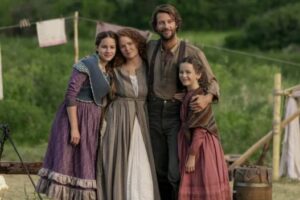
The Netflix version—and I drank in every minute of its eight episodes—follows the basic storyline of the Little House on the Prairie book, but diverges with some characters and plotlines. Importantly, it features a new emphasis on land ownership. Also, Ma Ingalls (Crosby Fitzgerald) has a role as a quiet but visible leader, and there’s a new emotional reason Pa (Luke Bracey) has dragged his family into dangerous territory (historically, the true story for Wilder’s family is one of financial and farming failure). These aspects help flesh out this familiar story in a new way.
The fictionalized Little House books were built on the narrative of an America when most single women couldn’t own land (not federally mandated until 1975), have a bank account (1974), or respectably work outside limited spheres of activity. They couldn’t vote, either; white women earned the right in 1920, Native American women in 1924, and all women—including Black women—only in 1965.

The first TV series, which premiered in 1974, was harkening back to a pioneering time right at the moment when women had gained several rights that were previously unavailable to them. Yet Wilder’s stories are still read by many almost as historical fact, without an understanding of that larger context.
In the books and the first TV series, Laura wore her sunbonnet loosely tied as a sign of defiance of expectations. I kept waiting for that to show up in the new series. To my surprise, Laura (Alice Halsey) rarely even wears a sunbonnet now, instead sporting a simple Stetson-style hat, given to her by a boy cousin, and girlish pussy-willow buds stuck in the brim. (Yes, I want one.)
Gone are the loose bonnet ties. Laura is who she is. In public, she and the Ingalls women wear unique straw confections, stiff and upright, that frame their faces like halos. They are not hidden by old-fashioned sunbonnets. Yet even with her slingshot skills and boyish hats, Laura gives no indication that she’ll step on the wrong side of the feminine line.
The new series—with all episodes directed entirely by women and a producing team of mostly women —includes someone telling Caroline, now a recognized truth-teller and a sought-after leader, that a woman can be anything she wants to be in the West. Not every woman, though: The successful Black female shop owner, Emily Henderson (Barrett Doss), isn’t welcomed into the Ladies Historical Society (an exclusion that happened regularly as history was written on the frontier). If a woman chooses to oversee a saloon, like Lacey Aubert (Rebecca Amzallag), the most independent white female character in the series, she is relegated to the literal outskirts of town. As for the Osage women, well, even the mission-educated among them, like White Sun (Alyssa Wapanatâhk), are virtually excluded.
My family arrived as settlers in the 1620s, fought in the American Revolution, and by the 1840s, my ancestors were moving westward in covered wagons. I still have a quilt my then 17-year-old great-great grandmother made on the Oregon Trail. The family settled in Washington Territory long before statehood.
This pioneer heritage was important to my family. As a kid, I totally identified with Laura. I embraced her. Did I know of the more complicated history growing up? No—or only in bits and pieces that were set aside as easily as a cross-stitch sampler. It wasn’t until later that I started connecting the threads.
And I’m not alone. In 2018, the Association for Library Service to Children removed Wilder’s name from its children’s book award (though she retains her honor as an award winner) over what the organization called “an inconsistency between Wilder’s legacy and the association’s core values,” after literary analysis brought to light insensitive portrayals of Black and Native American characters in her work. The new TV series does work against that, with Sonnenshine deliberately centering an Osage family alongside the Ingalls and working with Indigenous story consultants and directors.


Wilder’s profound love of landscapes and nature is also more prominent in the new series—you can practically inhale the fresh scent of the prairie. But the other fresh aspects of Netflix’s Little House world will likely be discussed more at length, especially on issues of territoriality, displacement, the representation of the Osage, and the Black characters in a Reconstruction-era nation. These issues were barely taught when I was in school in the early 1970s; they are being actively erased or denied in some corners now.